

Medina Stands Together
Medina Stands Together is a non-partisan, grassroots organization dedicated to protecting Medina County from the rapid expansion of data centers.
Our mission is to analyze the potential impacts, and to educate and organize the community to fight back against the data center takeover. We are pushing for total transparency and maximum community protection from our local city and county governments.
We work with other similar groups in our region to organize strategies to protect our communities from rising utility rates, environmental and public health risks, and the massive strain these facilities place on our land and natural resources.
Local Information
We're aware of about 50 acres of data centers currently operational in Medina County, and about 1900 acres of data center projects proposed or in construction.
Do you have additional information or updates? Please let us know at medinastandstogether@pm.me - thank you.
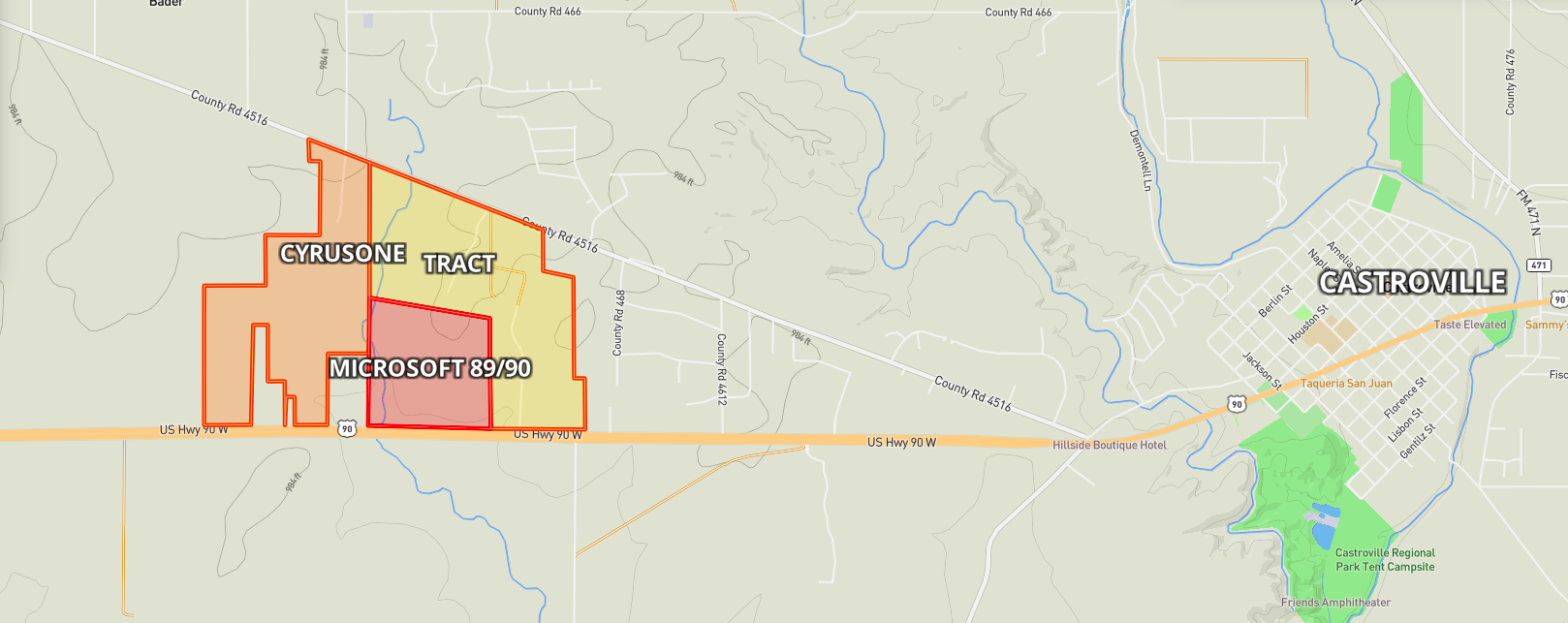
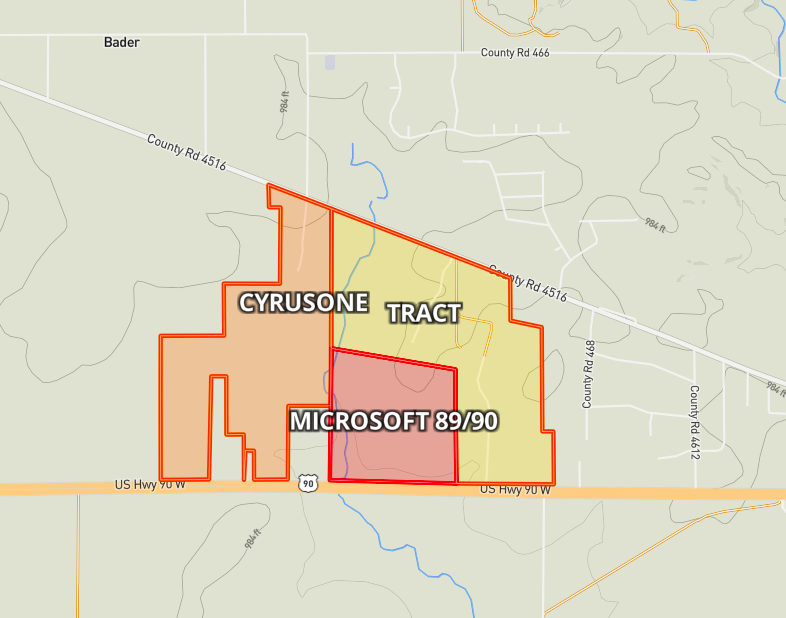
CyrusOne
CyrusOne project defeated in February in San Marcos
💵 $500 million project
🏛 Abatement (forgiveness) of 80% of County Taxes
⚡Unknown MW
🏭 400MW on-site gas fired powerplant
💼 CyrusOne (Subsidiary of Blackrock)
📍 244 acres (property appears intended for campus expansion)
Microsoft SAT89/SAT90
🏛 Annual cash grant equal to 80% of County Taxes
💼 Microsoft
⚡Unknown MW
📍 489,000 sq ft. building proposed
Tract/Medina Technology Park
⚡500 MW
💼 Tract
📍 265 acres
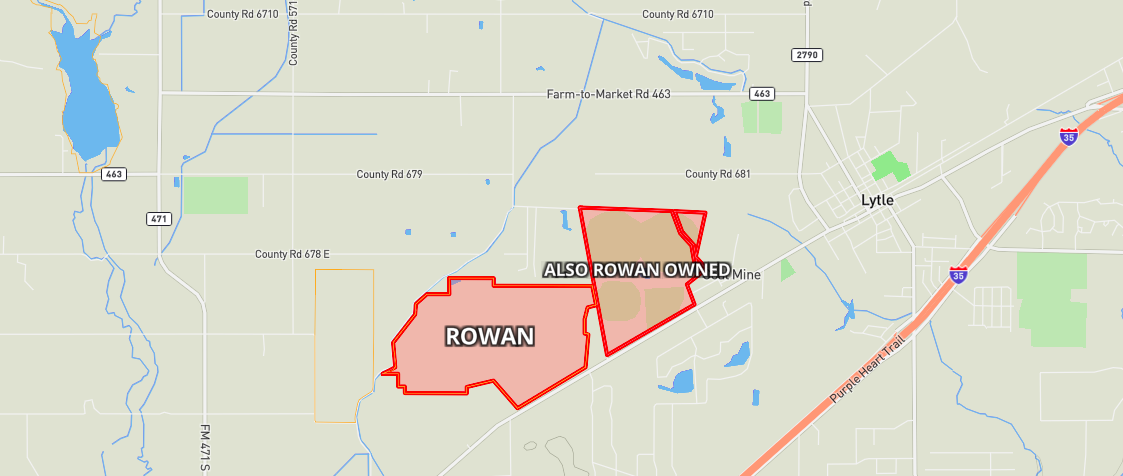
Rowan (Project Cinco)
In the news
💵 $900 million project
🏛 80% abatement of County property taxes
⚡ 300 MW
💼 Rowan
📍 440 acres
The project envisions up to 10 buildings (max ~350,000 sq ft each, up to 2 stories)
👤 Rowan’s language refers to an unknown ‘end user’, indicating they are developers, not owner-operators, and intend to sell the property to an undisclosed business to operate, once constructed.
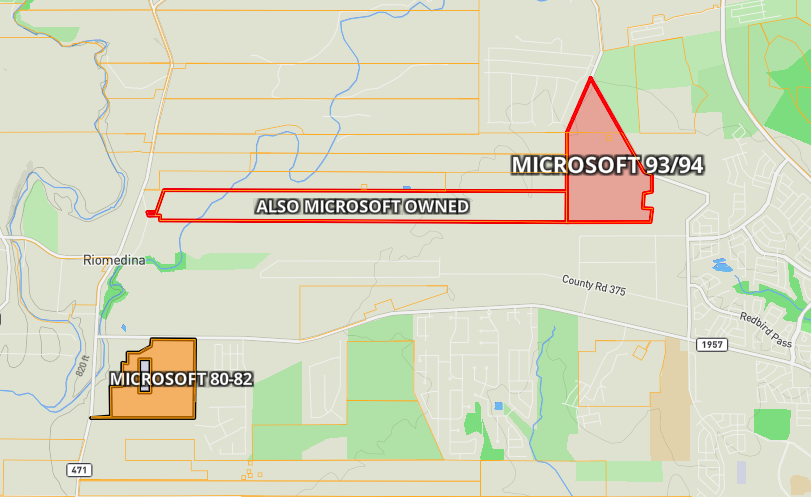
Microsoft 93/94
Microsoft filed two SAT93/94 registrations one year apart with identical building sizes but dramatically different estimated construction costs, therefore building numbers are unclear.
The specific site has not been publicly announced, but Microsoft has stated it will be on a previously-undeveloped (“greenfield”) site off CR 381. There is a large, undeveloped, Microsoft-owned tract off 381, likely the planned development site.
Of the projects listed, this in the earliest stage, with Microsoft intending to begin construction in early 2027.
💵 $350 million project
⚡ Unknown MW
💼 Microsoft
📍 245,000 sq. ft
The project envisions up to 10 buildings (max ~350,000 sq ft each, up to 2 stories)
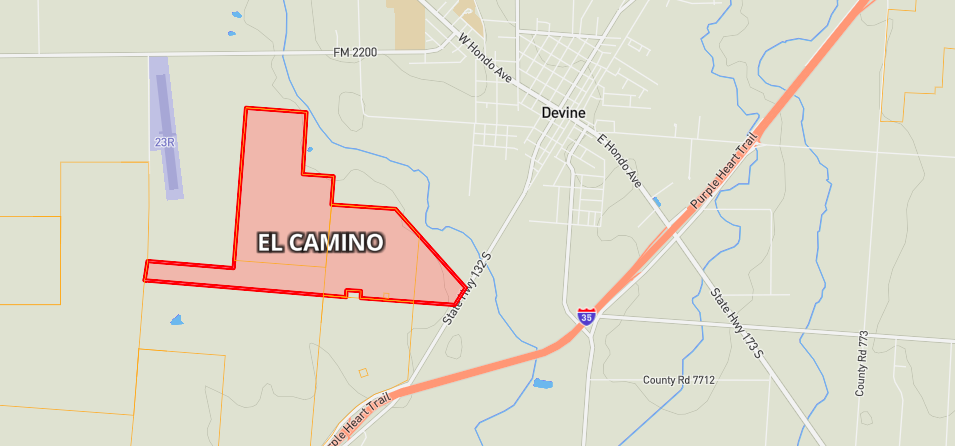
El Camino
In the news
⚡ 800MW
🏭 400MW on-site gas fired powerplant
💼 Texas Energy Group
📍 525 Acres on old Houston Bros. Ranch
El Camino was recently announced.
News
Events


Let’s Work Together
If you're interested in helping - reach out. We are currently organizing with churches, organizations, and Texas residents. Any one can help, as this affects all of us.
Frequently Asked Questions
-
Data centers are warehouses of small computers. But the current boom of DC construction builds facilities different in form and function to conventional data centers. Rather than storing data or supporting normal internet use, like some developers claim, these facilities might be better called “AI Centers”. They are mostly used to develop and operate “AI” software for a small set of big tech companies like Microsoft, Meta, OpenAI, Palantir, and Google.
The term "data center" is conventionally used to refer to much smaller facilities used to store digital information and operate internet services. Virtually all new data center construction is intended to create AI-development warehouses to produce new LLM models, which are rapidly being integrated into existing technology, raising major privacy concerns. Critics within the technology industry allege that regardless of the utopian ideas of what AI could do, in practice big tech funding is focused on data collection and surveillance.
-
However they feel about AI technology, financial experts across the board describe the sudden, massive investment in AI data centers as a financial bubble. The result of this is that developers are moving as quickly as possible to take advantage of investment capital, before the bubble bursts. The result of this has been rapid development, with projects often taking shape in behind-the-scenes tax abatement deals with county governments.
-
The huge data centers developments happening recently across Texas do not provide internet services to the average person. They are built to develop next-generation AI models for big tech investors.
Data centers have limited benefits to local communities. Tax abatements at the state and local level can mean communities see only a tiny fraction of the large investment, and long-term job positions are often minimal, especially compared apples-to-apples with industrial developments with a similar investment and footprint. There is also evidence of big tech companies lying about potential job prospects. -
Modern AI data centers use hundreds or thousands of Megawatts. For comparison, all of Medina County currently uses the equivalent of 97MW, a fraction of even the smallest modern data centers.
Across Texas, the electrical grid cannot support the data center boom without billions of dollars of upgrades. Despite the industry narrative, as it stands, the cost of those upgrades will be passed on to ratepayers. Across the country, in areas with heavy data center development, electricity rates have increased wholesale electricity costs as much as 267% for a single month, compared to five years ago, in areas near significant data center development. A few people might get jobs, but everyone will pay the cost. -
Without intervention, severe drought would push Texas’ towns and cities into critical water shortage by 2030. This projection from the Texas Water Development Board considers human population growth but the data center boom.
Many data centers use large amounts of water for construction and power generation. For cooling, modern AI data centers typically use closed-loop systems, where water or other thermal fluid is continuously circulated, cutting down on direct water use. However, this increases power use, which ultimately can increase indirect water use through power generation.
Closed-loop systems also raise major toxicity concerns, as this water can become toxic after circulation, and these systems are regularly flushed. Contaminants then released into the environment can include PFAs, cancerous so-called "forever chemicals", which do not degrade naturally, and are prohibitively expensive to filter out at municipal scale.
This is additionally a concern with recent legislation aimed at injecting industrial wastewater deep into aquifers, raising concerns about these chemicals irrevocably contaminating our regional water supply.
Talking Points
-
NO Tax Abatements
Not critical infrastructure
Health effects are serious and lethal
Increase of utility costs
Drought
Transparency
We have to deal with this now!
-
Data Centers in Medina County have been given millions of dollars in tax abatements.
City and County officials should not encourage data center developers when the people who elect them don’t want these projects in their community.
Tax abatements often matter for data center developers’ decisions to proceed. In April, representatives from Cloudburst Data Center admitted to the Guadalupe County Commissioners that their financing is borderline & they may not be able to proceed without tax abatements. Denying tax abatements may be enough in some cases to stop a project or at least get the developer to look elsewhere. On the other hand, giving away tax abatements attracts more data centers to come!
-
The overwhelming majority of basic internet functionality, including essential services, are supported by existing data center infrastructure. The data center industry tries to confuse the difference between existing small data centers and massive hyperscale AI data centers going in now, but there’s no comparison.
Developers want regular people to believe their needs will be met by new data centers, but they’re not for daily phone or internet use. The current boom is fueled by speculative investment in dangerously-underregulated AI technologies being pushed by a handful of billionaires for their questionable objectives.
Behind shell development companies, investment for data centers is typically Meta/Facebook, Microsoft, Oracle, Google, Amazon, or major AI firms.
Much of the technology being foisted on us is not desired by communities.
Ex. automated license plate readers, automatic facial detection and other privacy-eroding technologies, automated kill chain targeting…
When the data center industry corps like CyrusOne tells us these huge new developments are “critical mission infrastructure”, we have to ask - whose mission? What is the mission?
Health Effects
-
Recent research (University of Cambridge) shows data centers raise surface temperatures by an average of more than 3 degrees; in extreme cases, temperatures were more than 16 degrees higher
Data center heat islands can extend for more than 6 miles from the site
Heat stress is a major cause of death for livestock; increased temperatures would make farming and ranching more challenging in our region.
-
Living near a cluster of data centers is even worse for human health than living next to a gas-fired power plant (Virginia Commonwealth University); Caldwell County residents could be getting both.
Increase in smog and heat raises suicide risk (University of Utah)
Multiple data center projects in Caldwell Co. plan to build their own gas plants; Tract’s would generate twice the power of the largest gas plant in Texas.
On-site power plants at Caldwell County data centers would likely result in catastrophic health outcomes for residents.
Analysis of the onsite power generation from a 135 MW data center in Northern Virginia estimates up to $99 million of health damages each year from premature mortality, respiratory and cardiovascular disease.
Diesel generators - the dirtiest form of combustion, meant for actual emergencies
Back-up generators are tested regularly and used when the grid is strained, which could be quite often given that our current grid infrastructure cannot support so many large loads from data centers.
Generators emit fine particulate matter (PM10 and PM2.5), carbon monoxide (CO), nitrogen oxides (NOx), sulfur dioxide (SO2), and volatile organic compounds (VOC).
These pollutants cause asthma, heart attacks, dementia, cancer, lung disease.
Less than 1 GW of diesel generators inflict >%150 million in health costs in the “data center capital of the world” (Piedmont Environmental Council)
-
Data centers use proprietary cocktails of chemicals to cool servers. Coolant chemicals are kept secret with nondisclosure agreements, however they frequently contain hazardous substances;
water discharged can carry harmful carcinogens (PFAS, glycol, and heavy metals).
PFAS are persistent, bioaccumulating poisons which are not removed by wastewater treatment..
-
Data centers produce constant noise, which can reach 80-90 decibels
Persistent noise, even frequencies imperceptible to human hearing, can damage health; children and elderly are even more vulnerable
Chronic exposure to noise can cause or exacerbate cardiovascular disease; type 2 diabetes; sleep disturbances; stress; mental health and cognition problems, including memory impairment and attention deficits; childhood learning delays; and low birth weight.
Livestock and other creatures are also sensitive to noise pollution.
-
Power bills near data centers go way up. A 2025 Bloomberg study showed that in areas with significant data center development, wholesale electricity costs rose by up to 267%!
New York City uses 5.5 GW of power on average. If all five projects are constructed, the data centers in Caldwell County would use more electricity than the most populated city in the United States!
TX grid capacity would need to more than double in the next few years to accommodate data centers. Due to large loads, ERCOT has proposed a new 765-kV transmission plan that will cost Texas just over $32 Billion; this cost would be passed off to ratepayers.
-
Closed-loop cooling isn’t the issue: most water consumption in data centers is from power generation.
How much water are these massive power plants going to use? HARC (Houston Advanced Research Center) estimates 207 gal/MWh, which would amount to about 5 million gallons each day for a 1 GW data center.
Some data center developers claim water consumption is a “security” secret and will not disclose their onsite use.
New research from the University of Texas estimates data centers could use up to 9% of Texas’ water by 2040.
Closed-loop cooling isn’t the issue: most water consumption in data centers is from power generation.
How much water are these massive power plants going to use? HARC (Houston Advanced Research Center) estimates 207 gal/MWh, which would amount to about 5 million gallons each day for a 1 GW data center.
Some data center developers claim water consumption is a “security” secret and will not disclose their onsite use.
New research from the University of Texas estimates data centers could use up to 9% of Texas’ water by 2040.
They also shouldn’t use “reclaimed water”: Most of Texas’ river flow is effluent during much of the year. Calling it ‘wastewater’ or ‘reclaimed’ confuses the issue - overdrawing and misusing will dry up local water either way. Suggesting data centers use this water for their operations is not a solution.
-
City and County governments are often the first to hear about development projects, and need to share what they learn with their community.
People deserve to not be scrambling and overwhelmed. We need our elected officials to share information with the public promptly and proactively.
-
We have to work together to deal with this now, not hope we can solve it next year through the legislature
Every elected official in Medina County should be publicly demanding the Texas Legislature to call for a Special Session to provide regulatory relief for local governments.
At the same time, it is simply not true that the only way to address things is through state-level policy. Everyone knows the State has primary regulatory power – and that they are unlikely to do anything serious about data center development, especially anytime soon. Many communities around Texas are getting creative to test the boundaries of what can be done to protect our communities. We need to make things happen here, now – not far away, at some point in the future.